"Shigaraki - Twelve Artists' Ode to the Earth Exhibition II" Sumiko Aoki , Satoki Oonishi , Sueo Okuda , Shusaku Kanzaki [List of Works]
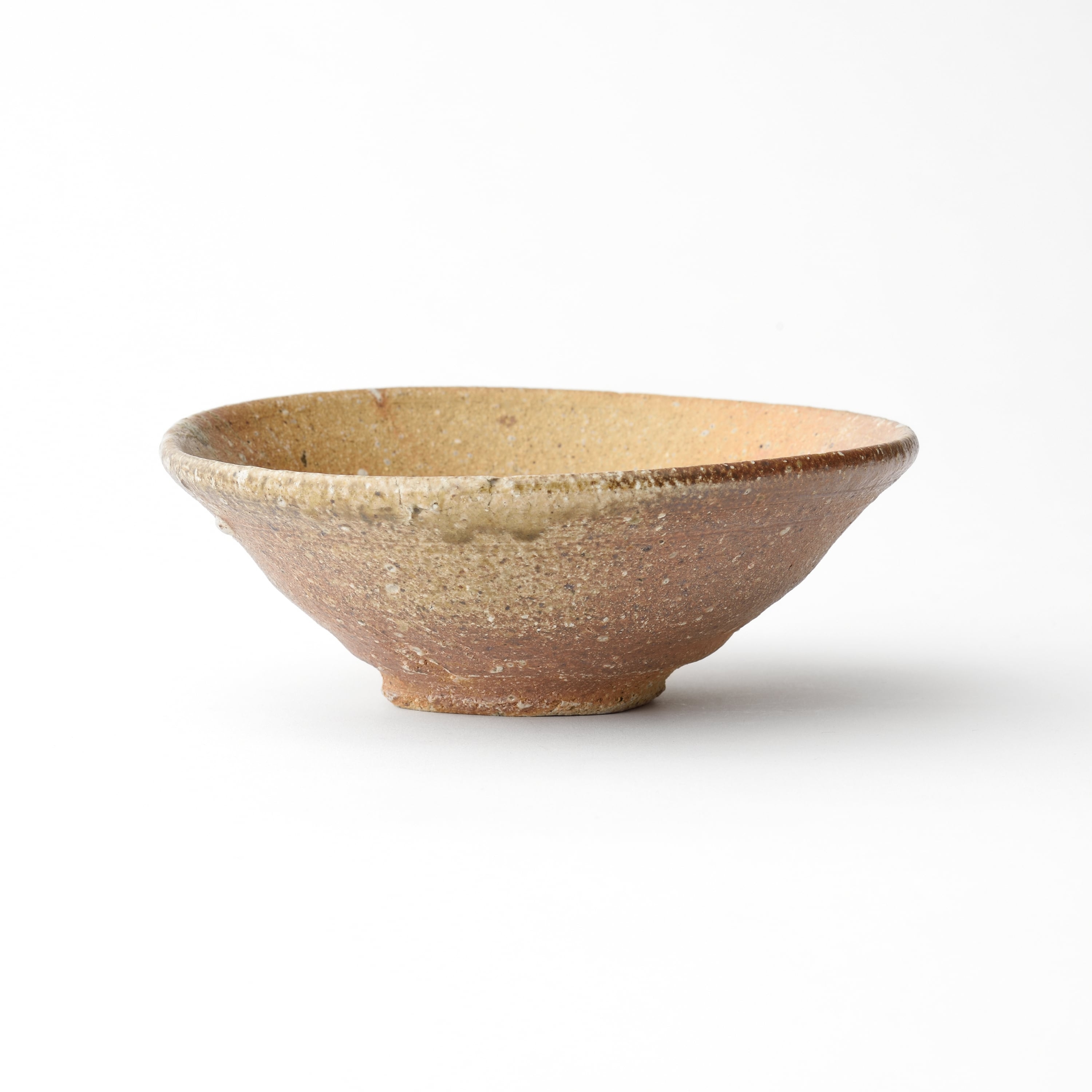
Shigaraki tea bowl / Made Sueo Okuda
| Exhibition period Schedule |
May 7, 2021 (Fri) – May 13 (Thu) May 7 - May 13, 2021 |
| Introduction Introduction |
This will be an online exhibition."Shigaraki - Twelve Artists' Ode to the Earth Exhibition II"This page showcases the works submitted by the following four artists.
Sumiko Aoki Aoki Sumiko[Work No.1-4] Satoki Oonishi Onishi Satoki[Work No.5-8] Sueo Okuda Okuda Sueo[Work No.9-12] Kanzaki Shusaku[Work No.13-16]
In addition to the works featured on the exhibition details page and in the direct mail, we will introduce four pieces from each artist. Please also,Exhibition details pagePlease also check out my other works.
Additionally, some artists have provided us with their thoughts and comments regarding the works exhibited in this exhibition. Unfortunately, this exhibition has had to be held online, so we hope that at least some of the creators' feelings towards their work will be conveyed to everyone. I've noted the details below each title, so I hope you'll take a look at them as well.
Online exhibition sales methodsThe details are as follows:
We will start accepting orders by phone from 11:00 AM on the first day of the exhibition, Friday, May 7th, when the gallery opens.
To maintain accuracy in the order of reception, we only accept reservations by phone; unfortunately, we cannot accept reservations by email or fax.
From May 8th (Saturday), the second day of the event, we will also accept orders via email and fax.
・The artwork you have purchased will be temporarily held at our gallery until the paulownia wood box and other necessary preparations are complete. Once the paulownia wood box arrives and the artwork is ready for delivery, we will contact you again regarding payment and shipping methods.
・For customers who will be able to visit our gallery in person, payment can be made in cash or by credit card (VISA and Mastercard only) at the store.For customers receiving delivery, we kindly request that you make a bank transfer to our gallery's bank account (Sumitomo Mitsui Banking Corporation). Please note that during the online exhibition period of this exhibition, there will be no transfer fees to our gallery's account.
・We will deliver your order to your specified address via Japan Post's Yu-Pack service. Please note that for orders under 20,000 yen (including tax), a separate shipping fee will be charged. For orders of 20,000 yen or more (including tax), delivery is free throughout Japan.
• If there are any works you would like to see that are not currently on display online on this website, please let us know. We will inquire with the artist about their availability.
We look forward to receiving your inquiries. |
| Biography Biography | ■ Sumiko Aoki Aoki Sumiko [I've been exploring empathy like a journey ever since I started making pottery.] Born in Nagoya City, Aichi Prefecture Completed graduate studies in Ceramics at Aichi Prefectural University of Fine Arts. In 1996, I began making pottery in Shigaraki. 1999: Selected for the Shigaraki Ceramic Art Exhibition. 2000: Built a kiln; selected for the International Craft Exhibition Itami. 2002: Selected for the International Ceramics Exhibition, Mino. Selected for the International Ceramics Exhibition Mino in 2008. 2013: Chozo Prize Ceramics Exhibition, Chozo Gold Prize (Grand Prix) 2014: 25th Shumei Cultural Foundation Award ■ Satoki Oonishi Onishi Satoki [Clay is a very fascinating material.] Sometimes it greatly disappoints expectations, and other times I find myself overjoyed to have obtained a treasure. I was worried and thinking about how to handle it. It can ignite a fighting spirit, lead you down a new path, and bring unexpected encounters. I think it's a once-in-a-lifetime encounter. Born in Shigaraki-cho, Shiga Prefecture in 1964. 1988: Graduated from Toyo University, Faculty of Sociology, Department of Applied Sociology. 1993: Graduated from Kyoto Prefectural Advanced Technical School for Ceramics, Department of Design. 2006: 17th Shumei Cultural Foundation Award 2007: Contemporary Ceramics Hagi Grand Prize Exhibition (Yamaguchi Prefectural Hagi Museum of Art) 2008: Grand Prize, 1st "Imadoki, Shigaraki, Kayariki" Exhibition 2013: Certified as a Shigaraki ware traditional craftsman (general category). 2018: Selected for the 11th Contemporary Tea Ceremony Ceramics Exhibition, and selected for the 3rd Japan Ceramic Society Encouragement Award Kansai Exhibition. ■ Sueo Okuda Okuda Sueo [To rise with a single sword] Born in Shigaraki-cho, Shiga Prefecture in 1966. 1987: Completed the Molding Course at Kyoto Prefectural Ceramic Arts Vocational Training School. 1994 Solo exhibition at Gallery Touen (Shigaraki) 2006 Solo exhibition at Gallery Touen (Shigaraki) 2013 Solo exhibition at Gallery Touen (Shigaraki) 2018 Solo Exhibition at Gallery Yu (Shizuoka) 2019: 30th Shumei Cultural Foundation Award, Five Artists' Exhibition of Fine Pottery (Oribe, Nagoya) 2020: 30th Shumei Cultural Foundation Award Commemorative Exhibition (Gallery Toen, Shigaraki) In addition, I have exhibited in group exhibitions in various locations throughout the Kansai region. ■ Shuusaku Kanzaki Kanzaki Shusaku [We inherit tradition, but we don't aim to be old-fashioned.] Works that are relevant to the times. Works created not as Shigaraki ware, but as the work of an artist. I want to create works that will endure in the present and into the future. Born in Shigaraki-cho, Shiga Prefecture in 1983. 2004: Graduated from Kyoto Prefectural Advanced Technical School for Ceramics. 2012: Selected for the 59th Japan Traditional Crafts Exhibition. 2013: Selected for the 60th Japan Traditional Crafts Exhibition. 2014 2nd Ceramics Exhibition Selected 2015: 44th Japan Traditional Crafts Kinki Exhibition, Newcomer Encouragement Award; 62nd Japan Traditional Crafts Exhibition, Selected for Exhibition. 2016: 27th Shumei Cultural Foundation Award 2017: Selected for the 5th Ceramics Exhibition 2018: Selected for the Hagi Grand Prize IV in Contemporary Ceramics, selected for the 65th Japan Traditional Crafts Exhibition, selected for the 3rd Japan Ceramic Society Encouragement Award Kansai Exhibition. 2020: Selected for the 67th Japan Traditional Crafts Exhibition. Regular Member of the Japan Crafts Association |
| Main exhibited works Main Exhibited Works |
|


| Author name | Sumiko Aoki |
| Work name | Tea bowl and Oribe I created this tea bowl hoping that you would enjoy decorating it as if you were turning the pages of a small picture book, and that you would happily admire it while rolling it around in your hands. |
| price | 40,000 yen (excluding tax) (44,000 yen including tax) |
| box | Comes with a paulownia wood box (to be delivered later) |
| size | Φ 9.8 × H 8.0 (㎝) |


| Author name | Sumiko Aoki |
| Work name | Tea bowls and pottery This tea bowl was created with the intention of being a work of art from every angle. It's a tea bowl filled with the desire to show it off and to be seen. I still remember the day I painted it. |
| price | 40,000 yen (excluding tax) (44,000 yen including tax) |
| box | Comes with a paulownia wood box (to be delivered later) |
| size | Φ 9.5 × H 8.5 (㎝) |


| Author name | Sumiko Aoki |
| Work name | Sake vessel This sake vessel was created based on the idea of dressing sake in an outfit I designed. I had a lot of fun making it. |
| price | Each item is 20,000 yen (excluding tax) (22,000 yen including tax). |
| box | Comes with a paulownia wood box (to be delivered later) |
| size | [From left] W 12.0 × D 8.5 × H 15.0 (㎝) W 14.5 × D 9.5 × H 10.2 (cm) [Sold] |


| Author name | Sumiko Aoki |
| Work name | Sake cup What's fun about sake is that you realize how much you've drunk from a tiny little cup like a guinomi. Making these guinomi was a lot of fun. I hope that comes across, even just a little. |
| price | Each item is 15,000 yen excluding tax (16,500 yen including tax). |
| box | Comes with a paulownia wood box (to be delivered later) |
| size | [From left] Φ 5.5 × H 6.0 (㎝) Φ 6.5 × H 5.2 (㎝) Φ 6.5 × H 6.0 (cm) [Sold] Φ 5.7 × H 5.0 (㎝) |


| Author name | Satoki Oonishi |
| Work name | Shigaraki ware, molded gray tea bowl [Eda clay] The Eda district of Shigaraki town, where this clay was produced, has been a place where clay has been mined since ancient times, and even now, many clay companies are located there. I heard that clay was being excavated at a construction site, so I was allowed to dig. The layers were thin, and red clay, white clay, and coarse sand were mixed in in streaks. I tried kneading it and making various things, but they were rough, didn't fire properly, leaked water, and all I could make were completely uninteresting. I almost gave up, but the texture of the sliced excavated clay was beautiful, so I tried to incorporate this texture into my work by hollowing out and carving the clay lumps. What I ended up with was slicing together clay lumps with various textures. It is what is called the tatara method, but although tatara is usually used to achieve uniformity in the clay, I deliberately did not knead it in order to take advantage of the natural beauty of the patterns that cannot be achieved by human hands. The texture is a product of chance, but this appearance is exactly as it was when the clay was formed about 2.5 million years ago. I wanted to show this appearance, so I started making tea bowls. Hard, soft, coarse, dense, clay, sand—I shaped the clay by hand, feeling my way through it to confirm its characteristics. When fired in the anagama kiln, the crimson color and the shading of the patterns came out naturally, but as expected, it was coarse and leaked. I applied glaze to the inside, filled the cracks, and tried to stop the leaks, repeatedly firing it in a kerosene kiln. As the clay and glaze intertwined and melted together, I truly experienced the fascinating process of firing pottery. For me, this clay was a once-in-a-lifetime encounter, a new discovery. This tea bowl, No. 2 on the exhibition page, is made of rougher, more rugged stone, making shaping it challenging. This difficulty is evident throughout the piece; while the exterior appears very irregular, it is surprisingly rounded. The interior is interesting, with thick layers of glaze accumulating during repeated glazing and firing, and iron content dissolving to create black patterns. Deciding which side to display as the front is difficult, but there is one hidden gem in this piece that can only be appreciated by drinking from it. It is revealed when you finish drinking, through a vitrified crack in the glaze. |
| price | 70,000 yen (excluding tax) (77,000 yen including tax) |
| box | Comes with a paulownia wood box (to be delivered later) |
| size | W 13.3 × D 12.5 × H 8.3 (㎝) |


| Author name | Satoki Oonishi |
| Work name | Shigaraki Hand-Molded and Hammered Tea Bowl [Asamiya Tea Field Clay] Shigaraki is a pottery producing area of the Six Ancient Kilns, but it is also the production area of Asamiya tea, one of the five most famous teas and the oldest in history. A few years ago, a friend of mine who is a tea farmer was replanting his tea fields when he came across some clay, and he brought it to me, saying he wasn't sure if it would work, but I should try it out. There were two types of clay: this one and a white, sticky clay. I'm quite a tea lover. I decided that if I were to make something, it would be teaware, and since the white clay was fine, pliable, and could be shaped on a potter's wheel, I made sencha teaware. What to do with this clay? The clay was sandy, slightly yellowish, and contained iron, and I felt that if fired in a wood-fired kiln, it would produce a reddish-scarlet color. I wanted to make a scarlet tea bowl. However, it wasn't very pliable, and even twisting it was difficult, so I was thinking about what to do. This time, after trying a technique I'd never attempted before—pounding, stretching, and shaping—with Ryuo clay, I realized it was possible with this clay as well. I roughly shaped it by hand, like a Raku tea bowl, let it dry for a while, and then pounded, stretched, and shaped it to refine the form, which allowed me to finally create a shape. I found the pounding technique interesting when working with this clay. I like how the overall color turned out to be a calm crimson. |
| price | 50,000 yen (excluding tax) (55,000 yen including tax) |
| box | Comes with a paulownia wood box (to be delivered later) |
| size | W 14.2 × D 13.6 × H 8.6 (㎝) |


| Author name | Satoki Oonishi |
| Work name | Shigaraki Hand-Molded and Hammered Tea Bowl [Kise Clay] Kinose clay is representative of Shigaraki clay. Hishi clay is white but contains a small amount of iron and is a strong kaolin clay mixed with long silica. It produces the beautiful crimson color characteristic of Shigaraki, but it's no longer being mined; I acquired this clay by chance. It wasn't very sticky, so I mixed in a little of another clay. I shaped the clay by hand, then hammered it into a polygonal form. When loading it into the kiln, I placed it in front of the fire, aiming for a pull-out firing. Pull-out firing involves moving the piece into the embers or onto a shelf. This piece was also moved around inside the kiln, and even went missing at one point, but I found it and decided to leave it there without pulling it out. Looking at the surface, you can see that there are hammered patterns, so the kiln transformation and firing patterns differ slightly from surface to surface. You can also see that the flow of the glaze is in multiple directions, which is an indication that the direction changed frequently. There are kiln marks on the foot where the glaze was removed. Satoki Oonishi |
| price | 80,000 yen (excluding tax) (88,000 yen including tax) |
| box | Comes with a paulownia wood box (to be delivered later) |
| size | W 14.7 × D 12.9 × H 8.4 (㎝) |


| Author name | Satoki Oonishi |
| Work name | Shigaraki Hand-Molded and Hammered Tea Bowl [Ryuo Clay] This clay, apparently sourced from Ryuo-cho in Shiga Prefecture, has been in a lump for quite some time. The only place outside of Shigaraki where high-quality white clay similar to Shigaraki clay is found is around Shinohara in the neighboring city of Yasu, so it's likely from the same geological layer. It tends to turn black when exposed to strong flames, but a slightly weaker flame produces an orange-red color. Because it's a strong clay, I tried adding some slightly weaker Shigaraki clay to improve the red color. Because I sifted the clay to a finer particle size, its plasticity decreased, making it difficult to create uninteresting shapes on the potter's wheel, and even hand-building was challenging. However, the clay didn't stick to my hands. I wondered if I could do it by hammering, and when I tried that, it stretched upwards and naturally formed slightly irregular shapes. This was my first time shaping clay by hammering, and after testing it with various shapes and materials, I was able to shape this tea bowl into the desired form by hammering it with a flat spoon. The crimson color turned out almost exactly the bright color I was aiming for, and I think the ash glaze on the surface that was strongly exposed to the flame is also a characteristic of this clay. |
| price | 50,000 yen (excluding tax) (55,000 yen including tax) |
| box | Comes with a paulownia wood box (to be delivered later) |
| size | W 13.0 × D 12.8 × H 7.8 (㎝) |


| Author name | Sueo Okuda |
| Work name | Shigaraki Iga tea bowl He rises, wielding a single sword. |
| price | 90,000 yen (excluding tax) (99,000 yen including tax) |
| box | Comes with a paulownia wood box (to be delivered later) |
| size | Φ 12.5 × H 10.8 (㎝) |


| Author name | Sueo Okuda |
| Work name | Shigaraki flower vase He rises, wielding a single sword. |
| price | 60,000 yen (excluding tax) (66,000 yen including tax) |
| box | Comes with a paulownia wood box (to be delivered later) |
| size | Φ 16.0 × H 24.0 (㎝) |


| Author name | Sueo Okuda |
| Work name | Shigaraki flower vase He rises, wielding a single sword. |
| price | 60,000 yen (excluding tax) (66,000 yen including tax) |
| box | Comes with a paulownia wood box (to be delivered later) |
| size | W 16.5 × D 16.0 × H 22.0 (㎝) |


| Author name | Sueo Okuda |
| Work name | Five Masters of Shigaraki |
| price | 30,000 yen (excluding tax) (33,000 yen including tax) |
| box | No box |
| size | Approximately Φ 17.5 × H 4.0 (cm) |


| Author name | Shuusaku Kanzaki |
| Work name | Shigaraki Tsukubai |
| price | 25,000 yen (excluding tax) (27,500 yen including tax) |
| box | Comes with a paulownia wood box (to be delivered later) |
| size | Φ 10.5 × H 13.5 (㎝) |


| Author name | Shuusaku Kanzaki |
| Work name | Shigaraki tea bowl |
| price | 40,000 yen (excluding tax) (44,000 yen including tax) |
| box | Comes with a paulownia wood box (to be delivered later) |
| size | W 13.0 × D 12.0 × H 8.5 (㎝) |


| Author name | Shuusaku Kanzaki |
| Work name | Shigaraki ware spouted bowl |
| price | 20,000 yen (excluding tax) (22,000 yen including tax) |
| box | No box |
| size | W 21.8 × D 16.5 × H 7.3 (㎝) |


| Author name | Shuusaku Kanzaki |
| Work name | Shigaraki Square Plate Set |
| price | 25,000 yen (excluding tax) (27,500 yen including tax) |
| box | No box |
| size | Approximately W 16.0 × D 16.0 × H 2.3 (cm) |
Regarding sales methods
- ・
- DMWe accept advance reservations for the works displayed on this website before the exhibition begins. We will contact you approximately 20 days before the first day of the exhibition.DMWe ship the items and upload information to this website at almost the same time.
- ・
- For those who are unable to visit our gallery in person, we are happy to accept orders by phone or email.
- ・
- We look forward to receiving your inquiries.