Thirty Bowls Exhibition by Five Artists
30 Chawans exhibition by five potters
A Thirty-Bowl Exhibition by Five Artists
| Exhibition period Schedule |
March 15, 2021 (Mon) – March 21 (Sun) March 15 - March 21, 2021 |
| Gallery opening hours Opening Hours | From 11:00 AM to 7:00 PM (until 5:00 PM on the final day, March 21st) Open every day during the exhibition period. Open daily 11 am to 7 pm except for March 21, when the gallery will close at 5 pm. |
| Exhibiting artist Artist | Masahiko Ichino Ichino Masahiko Hiromi Itabashi Itabashi Hiromi Makoto Kaneshige Kanesige Makoto Sajirou Tanaka Tanaka Satjiro Kiyoyuki Katou Kato Kiyoyuki |
| Introduction Introduction |
A tea bowl should be appreciated within the context of a tea room. Otherwise, the tea bowl will not reveal its true form. For appreciating tea bowls, the enclosed space of the tea room and the light within it are extremely important. Rikyu created a tea room—a space of artistic quality comparable to that of famous or Chinese artifacts—even without them. This was groundbreaking. This is also related to the fact that they did not use famous or imported tea bowls, but instead drank tea from modern ware bowls. One might argue that if one is to drink tea from a tea bowl made by a contemporary artist, then a suitable modern tea room is necessary. However, conversely, one could also say that tea utensils exist precisely because there is a tea room. In other words, the dimensions of the tea ceremony utensils are determined to fit the space of the tea room. It's no exaggeration to say that the true enjoyment of the tea ceremony lies within the tea room itself.
In his book "Famous Tea Bowls Speak," Haruzo Hayashiya writes, "I have come to the realization that tea bowls are not something to be 'looked at' but rather something to 'converse with.' And that those that speak deeply are the ones that are truly 'famous tea bowls.'" These are words that are very typical of Mr. Hayashiya, who lived his life as a tea master. He further states, "However, it is certain that no one has created a tea bowl that surpasses 'Snowy Dawn' (a tea bowl made by Kawakita Handeishi), and as someone living in the present, this is regrettable. Has the era in which great tea bowls could be created passed?"
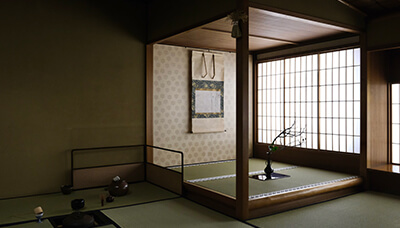
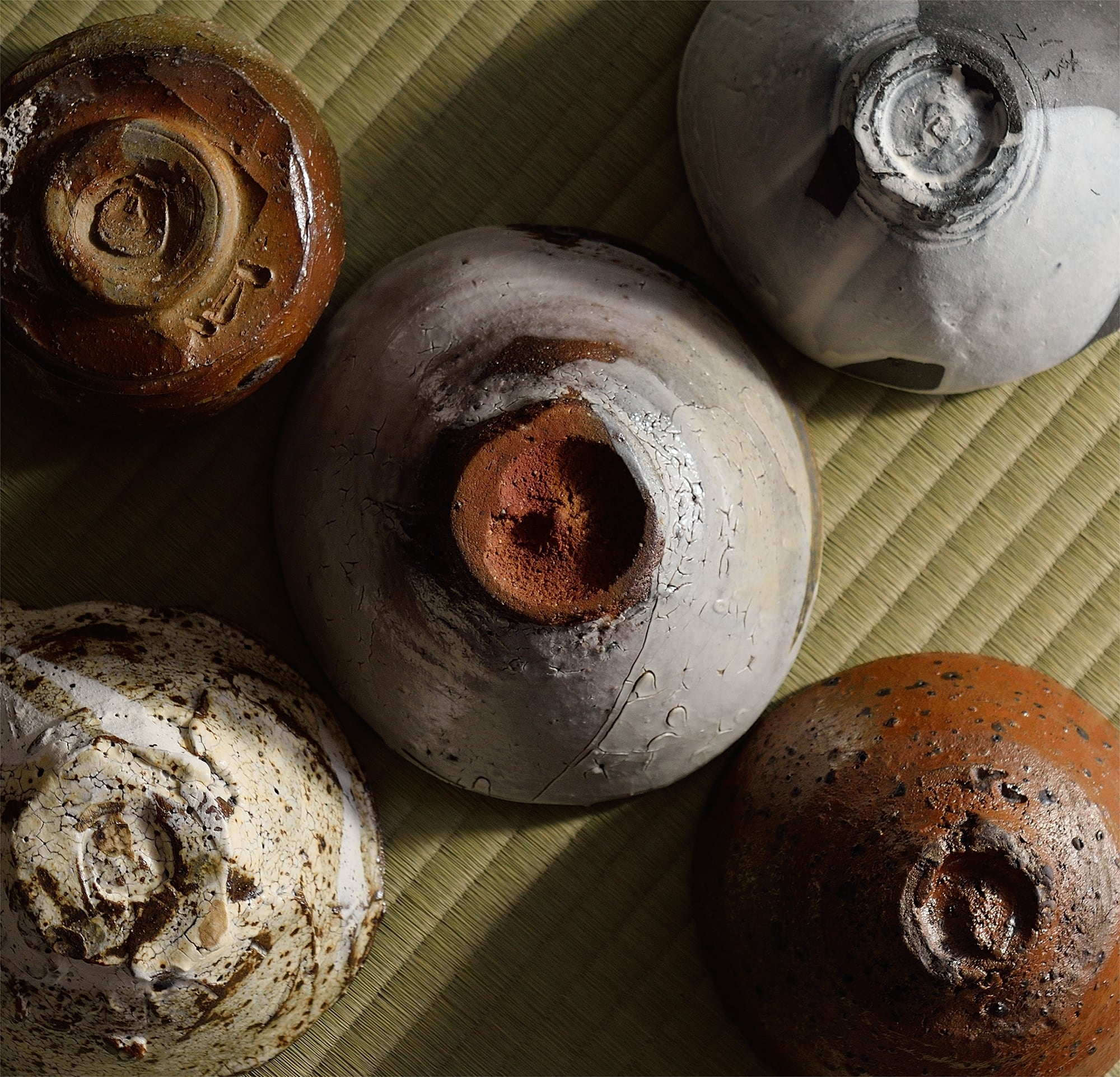
This time, we asked five artists— Masahiko Ichino (60 years old), Hiromi Itabashi (73 years old), Makoto Kaneshige (76 years old), Sajirou Tanaka (84 years old), and Kiyoyuki Katou (90 years old)—to create six tea bowls, each imbued with their utmost effort. I would like to express my sincere gratitude to the five writers who granted my request. Because, for any artist, there is no such thing as a tea bowl that is 100% satisfactory. That's why I believe there's meaning in challenging myself to create a truly exceptional tea bowl. The tea bowls featured in the direct mail were photographed in the "Ichiyoan" tea room at Kakiden in Shinjuku, in order to convey the appearance of each bowl as accurately as possible. I've included images of the rim, foot, and interior, which are key points to appreciate in tea bowls, but the illustrations are small, so I highly recommend seeing the actual bowls at the venue. Now, let me introduce the five artists and their tea bowls.
The youngest of the fiveMasahiko IchinoHowever, I turned 60 this year. There was a time when it was said that "you should only start making tea bowls after you turn fifty," but I think it's now okay to start making tea bowls without any reservations. The first Shinsui Ichino was a master at reproducing Korean tea bowls, and judging from this bowl, Ichino undoubtedly inherited that talent. When I place the tea bowl in the tea room and look at it, it reminds me of a famous Goryeo tea bowl, but this is the real deal.《Tanba Red Dobe Tea Pit》That is the case. It is made using the soil from Benten in Tanba Sasayama and is decorated with red clay. The black granules contained in the paddy soil give it a unique texture. And when you hold it in your palm, you can feel the gentle warmth unique to red slipware.
Hiromi ItabashiThe tea bowl is made starting from the base. It's not necessarily a perfectly rounded hill, but it doesn't deviate from the fundamental essence of a hill. The base is roasted with a burner to slightly harden it, and then the clay is shaped into a teacup while it is still soft. Without being bound by conventional notions of tea bowls, we explore the form that the clay itself desires to take. Without consciously thinking about shaping the mouth, I simply add lines and cut into the shape that naturally forms. The idea that the form changes depending on the production method is a very Itabashi-esque concept. Camellia Ash White Glazed Tea BowlThis piece is made by applying camellia ash over a white slip and firing it at 1260°. The pale rusty color on the makeup evokes the image of a camellia flower, and when combined with the color of the tea, it creates a sense of wabi-sabi (a Japanese aesthetic emphasizing simplicity and transience). This exhibition will feature various types of tea bowls, each created using these diverse methods.
As a tea bowl for deep conversation, among the many Bizen ware artists, I chose...Makoto KaneshigeI chose this tea bowl. Because this tea bowl, like its creator, is silent. If you want to have a deep conversation, a quiet tea bowl is better than an talkative one. thisBizen tea bowlThe sesame-like texture, the burnt edges, and the subdued reddish-brown surface create a quiet, ethereal beauty. The artist's deep feelings can be felt even in the way the base is carved with a spatula. It is never flashy, yet it is supported by Makoto Kaneshige 's unwavering aesthetic sense. The elevated viewpoint and the view from there are endlessly fascinating. This exhibition will also feature tea bowls other than Bizen ware. I'm looking forward to seeing what kind of tea bowls will be put up for auction.
Sajirou TanakaEach of these tea bowls is brimming with dynamism. thisKaratsu Kawakujira Teapot with the inscription "Rough Shore Waves"Even looking at the high ground, you can feel the intensity of the storm. As you gaze upon the dramatically undulating rim of the kiln, you can almost hear the sound of waves crashing in and out from somewhere. This tea bowl is accompanied by a waka poem written by the artist himself: "The rough waves of the shore are still there, and I await you all the more; may the plovers not cry, for the wind blows through the pines on the shore." The meaning is, just as the force of the rough waves crashing against the shore, my heart awaits you, my beloved. Plovers, please don't cry. I am enduring the strong wind like a pine tree on the shore. This is the author's love poem, born from a tea bowl.
Kiyoyuki KatouHe turned 90 last year. Up until now, I have described Kato's "ash-glazed tea bowls" as "the only tea bowls that allow you to drink tea without pandering to the tea itself," but looking at his new tea bowls from last year, I felt that he had surpassed even that notion. Having truly reached a state of ultimate freedom, the forms and patterns are expressed entirely according to the artist's heart's desires. 《Black clay and white clay tea bowl》This tea bowl was made using the slab-building method rather than the potter's wheel, and thanks to Kato's robust sculpting skills and refined sensibilities, it has been transformed into a modern tea bowl. Furthermore, the beveled rim gives it a very dynamic and lively feel. Every tea bowl made by this artist exudes a sense of cleanliness, and it feels refreshing and uplifting.
Kouichi Mori (Art critic, Standing Director of the Japan Ceramic Society) |
| Biography Biography | □ Masahiko Ichino Ichino Masahiko Born in 1961 in Sasayama City, Hyogo Prefecture. 1999: "100 Selections of Japanese Crafts Today" Exhibition (Mitsukoshi Etoile, Paris, France, etc.) 2006 Japan Ceramic Society Award 2010: Contemporary Tea - Freedom of Form (Kikuchi Kanbi Memorial Chishin Museum, Tokyo) Perspectives on Contemporary Crafts: Focusing on the Tea Ceremony (The National Museum of Modern Art, Tokyo, Crafts Gallery) 2011 Hyogo Prefecture Cultural Award Masahiko Ichino , 2015 - A Journey in Tamba (Hyogo Prefectural Museum of Ceramic Art) 2016 Utsuro no Katachi – Masahiko Ichino Ceramic Exhibition UTUWA (Paramita Museum, Mie) Following the Earth's Will – Masahiko Ichino Exhibition (LIXIL Gallery, Tokyo) Modern Crafts and the Tea Ceremony II (The National Museum of Modern Art, Tokyo, Crafts Gallery) 2020 National Crafts Museum Ishikawa Relocation Commemorative Exhibition - The Art of Crafts - Materials, Techniques, and Local Culture □ Hiromi Itabashi Itabashi Hiromi Born in Mitaka City, Tokyo in 1948. 1977: Completed studies at the Tajimi City Ceramic Design Institute. 1984: Grand Prize, China-Japan International Ceramics Exhibition 1991: Purchase Award at the 47th Faenza International Ceramics Exhibition (Italy) 1996: Grand Prize at the Izushi Porcelain Triennale (Hyogo) Professor, Department of Crafts, Kanazawa College of Art (2007-2014) 2018 " Keiji Itou & Hiromi Itabashi Two-Person Exhibition" Gallery Suki (Aichi) "Weightlessness within Gravity" Solo Exhibition at LIXIL Gallery (Tokyo) 2019: "Current Location: To Draw a Map of the Future," 21st Century Museum of Contemporary Art, Kanazawa (Ishikawa Prefecture) 2020 "OVERGLAZE" Solo Exhibition, Kan-Yusai (Tokyo) Member of the International Academy of Ceramics (IAC) □ Makoto Kaneshige Kaneshige Makoto Born in 1945 in Bizen City, Okayama Prefecture. In 1969, he graduated from the Faculty of Agriculture at Kyoto University and later studied under his father, Sozan Kaneshige. 1979 Independence 2011: Received the Sanyo Shimbun Cultural Merit Award Recipient of the Okayama Prefecture Cultural Award in 2019 To date, I have held numerous solo exhibitions in Tokyo, Osaka, Okayama, Munich, and other cities. □ Sajirou Tanaka Tanaka Sajiro Born in Fukuoka Prefecture in 1937. 1965: Began studying Jomon and Yayoi pottery and practicing hand-building. In 1971, he began his pottery-making activities after excavating the ancient kiln site of Hizen Karatsu. In 1975, he built a climbing kiln in Karatsu. In 2004, a climbing kiln was built in South Korea. Solo exhibition at Lotte Department Store in Seoul, South Korea in 2008. Solo exhibition in Geneva, Switzerland, 2014. 2016: Two-person exhibition of works by Munemaro Ishiguro in New York. □ Kiyoyuki Katou Kato Kiyoyuki Born in 1931 in Seto City, Aichi Prefecture. 1964-1965: Grand Prize at the Asahi Ceramic Art Exhibition 1970: Japan Ceramic Society Award 1987: Kiyoyuki Katou Exhibition from the Teshigahara Sofu Collection (Sogetsu Art Museum) 2005: Kiyoyuki Katou Exhibition: Forms and Sculptural Trajectories Created from Clay (Aichi Prefectural Ceramic Museum) 2007 Japan Ceramic Society Award, Gold Prize 2018 Kiyoyuki Katou Exhibition (Fukui Prefectural Ceramics Museum) He has served as the chairman of the judging committee for the Asahi Ceramic Art Exhibition and has also served as a judge for many other open-call exhibitions. |
| Artist in the gallery day Date Artist in Gallery | Masahiko Ichino Thursday, March 18th Hiromi Itabashi March 15th (Monday) Makoto Kaneshige March 15th (Monday) Sajirou Tanaka March 15th (Monday) and 16th (Tuesday) *Please note that due to the impact of the COVID-19 pandemic, there is a possibility that this information may change. |
| Exhibited works Exhibited Works | tea bowl |
| DM Direct Mail | This exhibitionDMSee(PDF) |
| notice Notice | ■Regarding sales methods 1. Works posted on this website We will accept reservations by phone starting at 11:00 AM on Saturday, February 27th. We apologize, but in order to maintain accuracy in the order of receipt, we cannot accept applications via email or fax. 2. All exhibited works not listed on this website Sales will begin as usual at 11:00 AM on the first day of the exhibition, Monday, March 15th, when the gallery opens. For those who are unable to visit the gallery, we will accept orders by phone, email, or fax from the same time. For details about the exhibited works, please feel free to contact our gallery. We look forward to receiving your inquiries. ■Possibility of changes to the event due to the COVID-19 pandemic We regret to inform you that, given the current COVID-19 situation, if we are asked to further restrict business operations, we may have to change the exhibition period and hours, or in the worst-case scenario, hold the exhibition online only. We would appreciate your understanding. We apologize for the inconvenience, but we will be posting the latest information on this website, so we would appreciate it if you would check it regularly. ■ Measures to prevent the spread of COVID-19 To ensure that all visitors can enjoy their time at our gallery with greater peace of mind, we are implementing the following measures to prevent the spread of COVID-19. We appreciate your understanding and cooperation. 1. A request to our valued customers We have placed alcohol-based hand sanitizer at the entrance of our gallery and the building. We kindly ask that you disinfect your hands upon arrival. Please wear a mask when you go out. Currently, if you have a fever or are feeling unwell, we kindly ask that you refrain from visiting the gallery. If you have visited a doctor or taken medication for fever or a cold within the past two weeks, or if you have traveled abroad, we kindly ask that you refrain from visiting the gallery. To help reduce crowding in the store, we kindly ask that you visit in small groups whenever possible. We regret to inform you that, for the time being, we will be suspending the tea service, including gyokuro tea, which we previously offered to our customers during the COVID-19 pandemic. 2. What our gallery is working on We installed a high-performance ventilation system, "Lossnay" (manufactured by Mitsubishi Electric), in our gallery on January 6, 2021. This new, powerful ventilation system ensures that all the air in our gallery is replaced every 15 to 20 minutes. In addition, the entrance door is kept open at all times to ensure even better ventilation. • We use SHISEIDO's hand sanitizer. It contains moisturizing ingredients that are gentle on the hands, and has been well-received by our customers. We will further strengthen our daily cleaning procedures. We regularly disinfect with alcohol on frequently touched surfaces such as elevator buttons, tables and chairs, entrance door and toilet handles, brushes and pens, even during business hours. If our gallery becomes crowded with many visitors and we determine that it is becoming too close to the public, we may ask you to limit entry to the gallery. Our gallery staff will wear masks, undergo temperature checks and health monitoring, and thoroughly disinfect their hands with alcohol while serving customers. On January 20, 2021, all staff members underwent PCR testing (at Nishitan Clinic), and all tested negative. We will continue to conduct PCR tests throughout the year. We sincerely look forward to your visit to our gallery. |
| Main exhibited works Main Exhibited Works |
|


| Author name | Masahiko Ichino |
| Work name | Tanba Red Dobe Tea |
| price | 280,000 yen (excluding tax) (308,000 yen including tax) |
| box | Comes with a paulownia wood box (to be delivered later) |
| size | φ 14.6 × H 8.0(㎝) |


| Author name | Hiromi Itabashi |
| Work name | Camellia ash-white glazed tea bowl |
| price | 200,000 yen (excluding tax) (220,000 yen including tax) |
| box | Comes with a paulownia wood box. |
| size | W 16.3 × D 15.6 × H 7.8(㎝) |


| Author name | Makoto Kaneshige |
| Work name | Bizen tea bowl |
| price | 400,000 yen (excluding tax) (440,000 yen including tax) |
| box | Comes with a paulownia wood box (to be delivered later) |
| size | W 12.7 × D 10.7 × H 8.2(㎝) |


| Author name | Sajirou Tanaka |
| Work name | Karatsu Whale Teapot Inscription: Araiso Nami |
| price | 1,000,000 yen (excluding tax) (1,100,000 yen including tax) |
| box | Comes with a paulownia wood box (to be delivered later) |
| size | W 17.8 × D 16.0 × H 8.8(㎝) |


| Author name | Kiyoyuki Katou |
| Work name | Black clay colored tea bowl |
| price | 380,000 yen (excluding tax) (418,000 yen including tax) |
| box | Comes with a paulownia wood box (to be delivered later) |
| size | W 15.8 × D 14.6 × H 8.3(㎝) |


| Author name | Masahiko Ichino |
| Work name | Tanba Benten White Tea Pit |
| price | 250,000 yen (excluding tax) (275,000 yen including tax) |
| box | Comes with a paulownia wood box (to be delivered later) |
| size | W 15.0 × D 13.6 × H 8.5 (㎝) |


| Author name | Hiromi Itabashi |
| Work name | black glaze bowl |
| price | 200,000 yen (excluding tax) (220,000 yen including tax) |
| box | Comes with a paulownia wood box (to be delivered later) |
| size | Φ 10.6 × H 10.0 (㎝) |


| Author name | Makoto Kaneshige |
| Work name | Shigaraki tea bowl |
| price | 400,000 yen (excluding tax) (440,000 yen including tax) |
| box | Comes with a paulownia wood box (to be delivered later) |
| size | W 12.0 × D 11.0 × H 9.2 (㎝) |


| Author name | Sajirou Tanaka |
| Work name | Oido Chagō |
| price | 1,600,000 yen (tax included) |
| box | Comes with a paulownia wood box (to be delivered later) |
| size | W 15.2 × D 14.8 × H 10.2 (㎝) |


| Author name | Kiyoyuki Katou |
| Work name | ash glaze tea bowl |
| price | 380,000 yen (excluding tax) (418,000 yen including tax) |
| box | Comes with a paulownia wood box (to be delivered later) |
| size | W 14.6 × D 14.5 × H 7.2 (㎝) |


| Author name | Masahiko Ichino |
| Work name | Tanba Red Dobe Tea |
| price | 280,000 yen (excluding tax) (308,000 yen including tax) |
| box | Comes with a paulownia wood box (to be delivered later) |
| size | W 15.4 × D 13.8 × H 8.8 (㎝) |


| Author name | Hiromi Itabashi |
| Work name | White glazed black clay bowl |
| price | 200,000 yen (excluding tax) (220,000 yen including tax) |
| box | Comes with a paulownia wood box (to be delivered later) |
| size | W 15.2 × D 14.5 × H 7.0 (㎝) |


| Author name | Makoto Kaneshige |
| Work name | Shino tea bowl |
| price | 500,000 yen (excluding tax) (550,000 yen including tax) |
| box | Comes with a paulownia wood box (to be delivered later) |
| size | W 12.8 × D 12.5 × H 9.2 (㎝) |


| Author name | Sajirou Tanaka |
| Work name | Qingxiao Tea Bag Signed Amatsumi Sora |
| price | 1,200,000 yen (tax included) |
| box | Comes with a paulownia wood box (to be delivered later) |
| size | W 16.3 × D 16.0 × H 8.0 (㎝) |


| Author name | Kiyoyuki Katou |
| Work name | Black clay colored tea bowl |
| price | 380,000 yen (excluding tax) (418,000 yen including tax) |
| box | Comes with a paulownia wood box (to be delivered later) |
| size | W 15.6 × D 15.0 × H 8.0 (㎝) |


| Author name | Masahiko Ichino |
| Work name | Tamba Tea House |
| price | 250,000 yen (excluding tax) (275,000 yen including tax) |
| box | Comes with a paulownia wood box (to be delivered later) |
| size | Φ 13.0 × H 9.0 (㎝) |


| Author name | Hiromi Itabashi |
| Work name | Camellia ash-pink tea bowl |
| price | 200,000 yen (excluding tax) (220,000 yen including tax) |
| box | Comes with a paulownia wood box (to be delivered later) |
| size | W 14.0 × D 13.0 × H 8.0 (㎝) |


| Author name | Makoto Kaneshige |
| Work name | Shigaraki tea bowl |
| price | 400,000 yen (excluding tax) (440,000 yen including tax) |
| box | Comes with a paulownia wood box (to be delivered later) |
| size | W 12.5 × D 10.8 × H 8.0 (㎝) |


| Author name | Sajirou Tanaka |
| Work name | Yunxiao Tea Bag Inscription: Coming Waves |
| price | 1,000,000 yen (tax included) |
| box | Comes with a paulownia wood box (to be delivered later) |
| size | W 12.0 × D 11.3 × H 10.0 (㎝) |


| Author name | Kiyoyuki Katou |
| Work name | ash glaze tea bowl |
| price | 380,000 yen (excluding tax) (418,000 yen including tax) |
| box | Comes with a paulownia wood box (to be delivered later) |
| size | W 14.2 × D 13.8 × H 7.4 (㎝) |